
Choose the Surry County Land Record That Fits the Question
The Clerk records far more than simple sale deeds. A single property transfer may sit beside a deed of trust, a later release, a plat or a judgment-related instrument in the same index. The document name tells you only what kind of record you have. It does not settle priority, title or whether a loan is paid. Treat the instrument table as a map of what the county index covers, then open the actual record and any filings that came after it before drawing conclusions about the parcel.
| Deed Type | What It Does | Common Use |
|---|---|---|
| Land-transfer deed | Records a conveyance and legal description | Identify a grantee and link the chain |
| Deed of trust | Records a security instrument against land | Review financing and later release records |
| Release deed | Records a release or satisfaction in the covered books | Check for a later filing after a deed of trust |
| Plat | Records a map or subdivision description | Compare lots, boundaries and legal descriptions |
| Judgment or UCC record | Indexes covered liens or financing statements | Confirm party, property relationship and release |
A deed conveys an interest. A deed of trust secures an obligation. A release or satisfaction is its own separate instrument. A UCC filing can appear in the Clerk's index. That does not make it a real-estate lien at all. Read the record itself. Then read any later release too. Do not treat every index hit as a transfer of ownership.
Surry County Deed Records Span Computer and Scanned Indexes
The Surry subscriber agreement lays out land-record coverage in unusual detail. The computerized index starts January 1, 1984. Scanned indexes with linked images cover January 1, 1848 through December 31, 1983. Deed images reach back further. They include book 1 from 1792, books 2 through 9 and 11 forward, plus older books 4 through 8 and 10 through 13 covering the 1741-1792 period. The agreement also lists deed-of-trust books 1 through 23 and 16A. It adds release books 1 and 2, and all plats.
These ranges describe the image inventory the agreement lists. They are not a promise that every record surfaces through a single online form. For older research, note whether you are working from an index book, an image volume or an archive finding aid. That keeps the source behind each deed clear. The live SRA search fields and document-type choices are best confirmed on the portal itself.
The Surry Clerk's site links to local land-record access information.
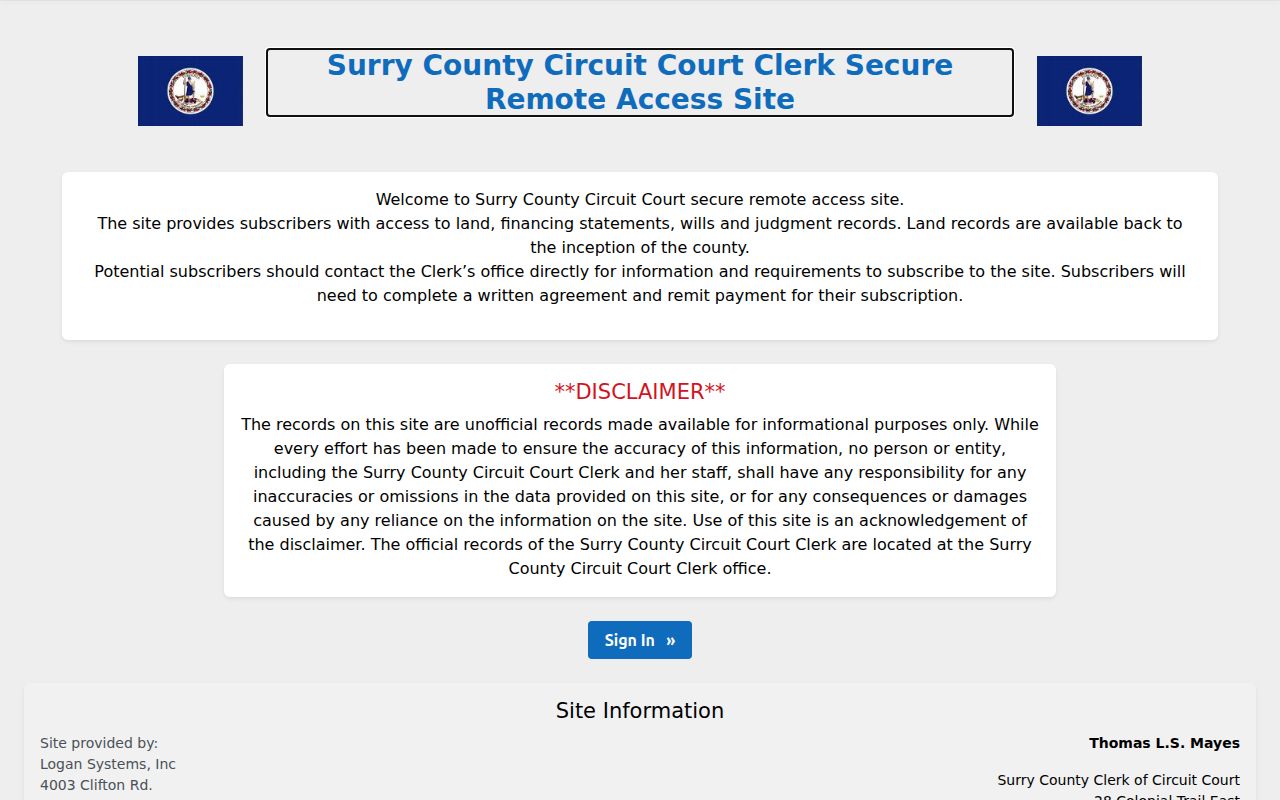
The Clerk page opens the door to the agreement. It does not display individual deed results itself. Virginia SRA's land-record search is the remote index and image doorway the Clerk points to.
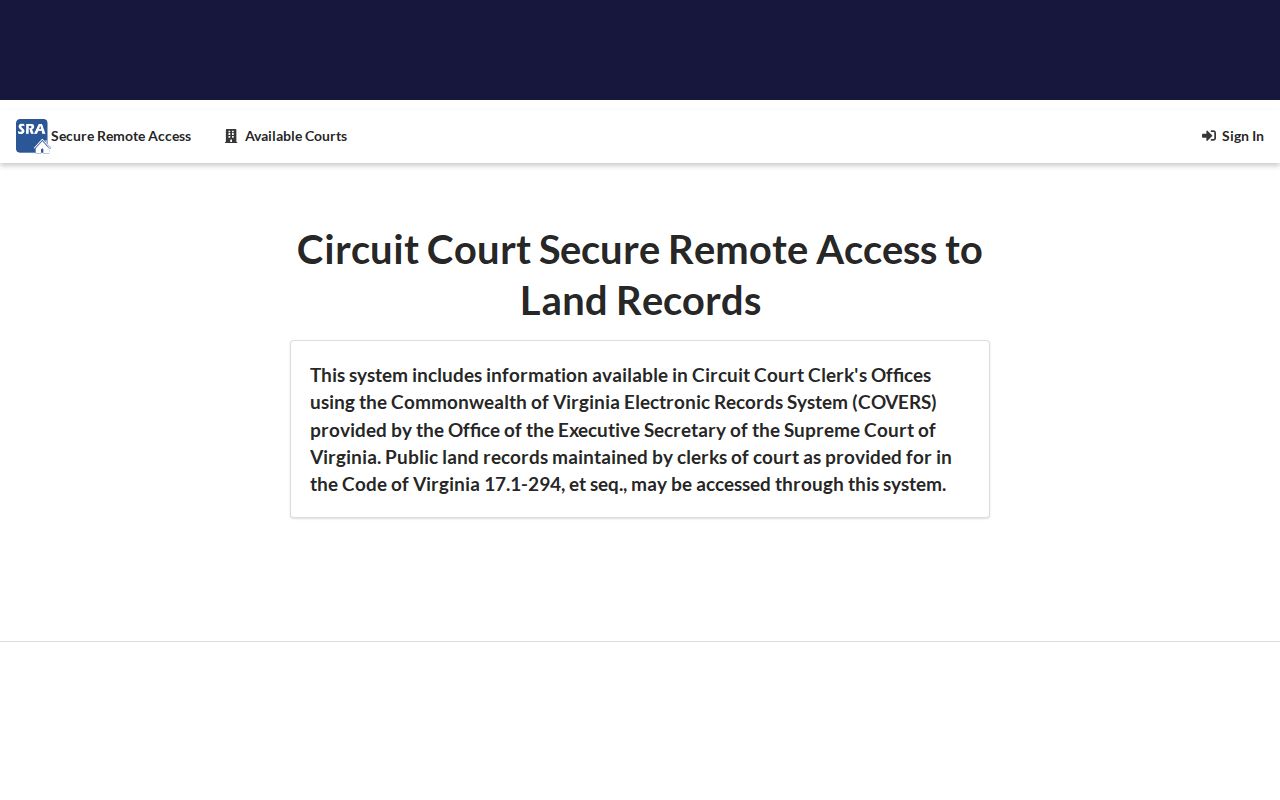
The SRA screen displays the statewide login and search entry. It is not a Surry deed result, and it makes no free image promise.
Fields to Verify in the Surry County Deed Index
The subscriber agreement offers no complete list of live search fields. The party-based route is documented. Use the grantor and grantee relationship plus the instrument reference. Then open the image when access allows. Treat any field list as a verification checklist only. Confirm the actual labels and document-type choices on the current portal or with the Clerk. Do this before relying on one search mode.
| Field or result | Role in the search | Verification note |
|---|---|---|
| Grantor and grantee | Connects the parties transferring and receiving an interest | Search both sides when tracing backward |
| Recording date or date range | Narrows same-name results | Live field layout not captured |
| Instrument or book/page reference | Identifies the recorded item for retrieval | Copy the reference exactly from the result |
| Document type | Separates deeds, trusts, releases, plats and covered liens | Dropdown options need live verification |
| Legal description | Matches a record to the land | Compare to CAMA or a recorded plat |
Trace a Surry County Deed From Grantee to Grantor
The index supports a backward chain. Begin with a known grantee. Locate the deed describing the parcel. Read the grantor who conveyed it. Search that earlier party as a grantee to reach the next link back. A street address is not a verified SRA search key. Start in CAMA or GIS and carry the parcel number and legal description forward. At each step, compare acreage, neighbors and boundary calls. That way you do not stitch together records for a same-name owner or the wrong tract.
- Find the target parcel in CAMA and copy the owner and legal description.
- Search the owner as grantee and identify the deed that describes the same land.
- Record the grantor and instrument reference, then search that grantor as grantee.
- At the 1984 index boundary, use scanned books; for earlier years, use older deed books or LVA reels.
- Grantor
- The party who conveys the interest described in the instrument.
- Grantee
- The party who receives that interest.
- Chain of title
- The linked sequence of recorded transfers for one tract.
- Reference
- Copy the book/page or instrument number exactly as the record presents it.
Older Surry County Deed Records at the Library of Virginia
The LVA ARVAS catalog lists Surry County deed books from 1746 through 1787. They sit on microfilm reels 15 and 18. Two volumes hold 826 pages in all. The books record grantor, grantee, residence, and property description. Indexes sort first and last names alphabetically. That gives researchers a named archive trail for early deed work. It is firmer than a generic genealogy suggestion.
A separate list in the SRA agreement reaches into older image books covering 1741-1792. The catalog and the agreement overlap. Yet they do not describe the same collection in identical terms. When a chain of title crosses into that era, keep the exact source range. Also keep the reel or book reference alongside the deed notes. LVA public microfilm viewing is free, per its genealogy information. Copy and research charges can vary.
The LVA catalog entry identifies the reels and the indexed fields.
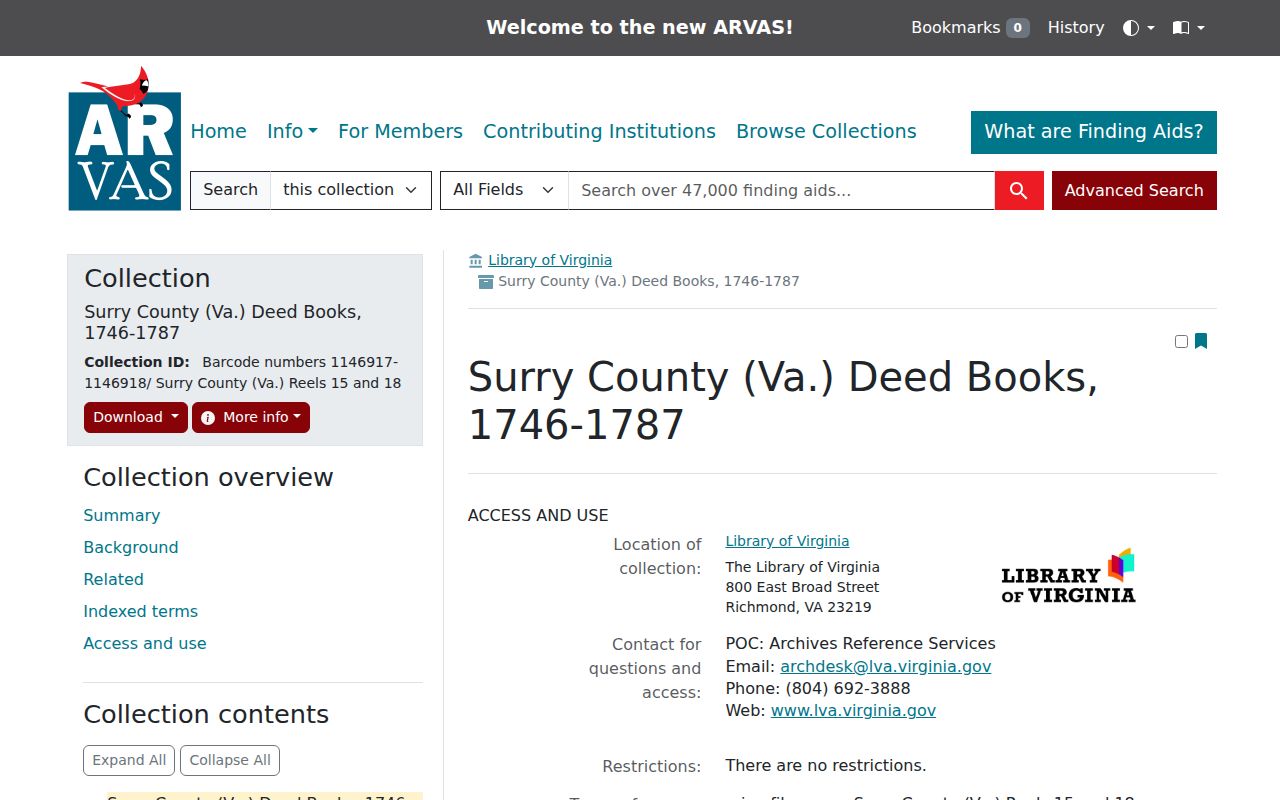
Use the catalog to locate the source, then compare each description against the current parcel.
Deeds of Trust and Release Books in Surry County
The SRA coverage list names deed-of-trust books 1 through 23 and 16A. It also lists release deed books 1 and 2. A deed of trust is an encumbrance record, not a deed transferring ordinary ownership. A later release may show satisfaction. Yet the title effect still depends on the instrument and anything filed after it. Search by the parties and match the parcel description. Do not assume an address search will surface every related record.
For an older loan, review the coverage book and date carefully. For a recent mortgage, confirm current index and image access with the Clerk. The agreement states no exact copy fee. The portal's dropdown list is best checked directly. A title examiner may need the original obligation, its releases and priority, not a single result line.
Surry County Judgment Liens and UCC Records Have Separate Ranges
SRA's subscriber attachment draws two separate coverage lines for Surry County lien research. Computerized UCC data runs from January 1, 2000 forward. The judgment-lien index starts on that same date. Scanned judgment-lien books reach further back, covering March 30, 1979 through August 23, 2002. These statements describe what the SRA data includes. They are not a legal opinion on every lien touching a parcel.
One caution matters here. A UCC filing can list collateral that never touches real estate. A judgment lien must be matched to the right debtor and the right property before it means anything. Look for a release, satisfaction, or court order. A title professional can then weigh priority questions the index cannot answer. The Clerk remains the local contact for recorded instruments. Virginia SCC's filing system tracks business and UCC records in a separate state-level system.
Surry County Plats Link Deed Text to Parcel Shape
Every plat recorded in Surry County falls within the SRA agreement's coverage. A plat does a job no deed text can. It pins subdivision lots and block relationships on paper. Rural land often travels by metes-and-bounds instead, with acreage, neighbor names, and natural features carrying the description. County GIS can orient a parcel quickly. It is not a survey, and an online map line never controls the legal boundary. Match the plat's lot, block, and book reference back to the deed itself.
Planning applications run on a different track. The county Planning page posts preliminary-plat and land-disturbance documents, but a preliminary filing is not a recorded final plat. Older chains add their own wrinkles. Whether the tract sits in Claremont Colony, began as a Dendron mill lot, or lies near the old courthouse, a historical place name can point toward the right instrument. The legal description still has to match. The Surry County parcel map guide shows how the GIS map can orient that document search.
Request a Surry County Deed Image or Clerk Copy
Remote deed images run through SRA under the local Clerk's access settings. Virginia splits access in two. A clerk may enable index-only viewing without charge. Images, though, require clerk-authorized access. Surry's subscriber agreement lists a $600 annual charge, one username and password, automatic yearly renewal, and 24-hour access except maintenance. The agreement names no exact counter-copy fee. Confirm the amount with the Clerk. The office sits at 45 School Street, P.O. Box 203, Surry, Virginia 23883, telephone 757-294-3161.
When requesting, give the parties, the recording date, and the instrument reference if known, plus the legal description or map number. Tracing past owners is a different task. The former-owner deed-chain guide describes the backward index method for deed records.
Recorded, not guaranteed. The Surry County deed index shows instruments of record, not every unrecorded interest or the final legal effect of a chain. It is not a title opinion; use a qualified title professional when clear ownership must be established.