
Separate the Three Numbers Called Surry County Property Value
Three different numbers can answer as a Surry County property value. One is the assessment the Commissioner keeps on the roll. One is an estimate of market value. One is the price written into a deed at the Clerk's office. Each comes from a different place and a different date. A sale price may not even show up as a checked field on the online parcel card. Before you search Surry County property records by address, note the assessment year and the deed date. That way you compare like with like. An assessor's figure serves the tax bill, not a promise of today's market price.
| Value | What It Is | Where |
|---|---|---|
| Assessed value | County valuation used for real-estate taxation as of an effective date | Commissioner / CAMA |
| Fair-market value | Valuation concept behind the assessment, not a guaranteed sale amount | Assessment materials |
| Recorded consideration | Sale-related amount reflected in a deed or recordation-tax process | Recorded instrument; display not verified |
| Land and improvement split | Fields to verify if the current parcel card provides them | Commissioner / CAMA |
Virginia requires assessments at 100 percent of fair-market value. Surry applies no routine fractional ratio. That rule still doesn't force assessments and sale prices to match. A family transfer, odd financing, personal property folded into the deal, or a gap in dates can push consideration away from the assessed figure. A shifting market can do the same. The statewide sales-ratio study is a statistical check. It is not a second tax rate on your bill.
Virginia's 100 Percent Rule Sets the Surry Assessment Basis
Virginia Code §58.1-3201 sets the standard. Local real-estate assessments must sit at 100 percent of fair-market value. In plain terms, the jurisdiction cannot take an appraisal. It cannot multiply it down by a routine 40- or 60-percent level before it lands on the roll. Statewide assessment-to-sales ratio studies compare assessments against bona fide sales. They gauge how close each locality comes to that statutory basis. The published locality ratio is a diagnostic, not a rate anyone charges.
Surry's 2025 FAQ adds a caution of its own. Fair market value is not necessarily what one buyer paid for one property. An assessment estimates value at its effective date. A sale, by contrast, may carry unusual terms. It may also happen under conditions far from the typical market. When a value confuses you, preserve the year. Ask the Commissioner how the parcel characteristics were treated. Virginia Code §58.1-3201 states the assessment standard in full.
The 2025 Surry County Property Value Effective Date
Surry's CAMA disclaimer reports a last general reassessment effective January 1, 2025. That date anchors every value field you read. It does not claim each parcel's value equals a sale price from that day. Nor does it say the roll refreshes each time a house changes hands. The county's online data notice says transfers, wills and plats recorded after January 1 post to the online real-estate roll the following year.
Keep the valuation date apart from the transfer date. A recently sold parcel may show different dates and names on its latest deed. Its assessment may not match. The county's 2025 appeal calendar set late-February appointments. It set a February 28 filing deadline, and results before March 31; that cycle has closed. Ask the Commissioner for a current schedule instead of treating an old appeal form as an open window. The CAMA disclaimer records both the effective reassessment date and the online transfer lag.
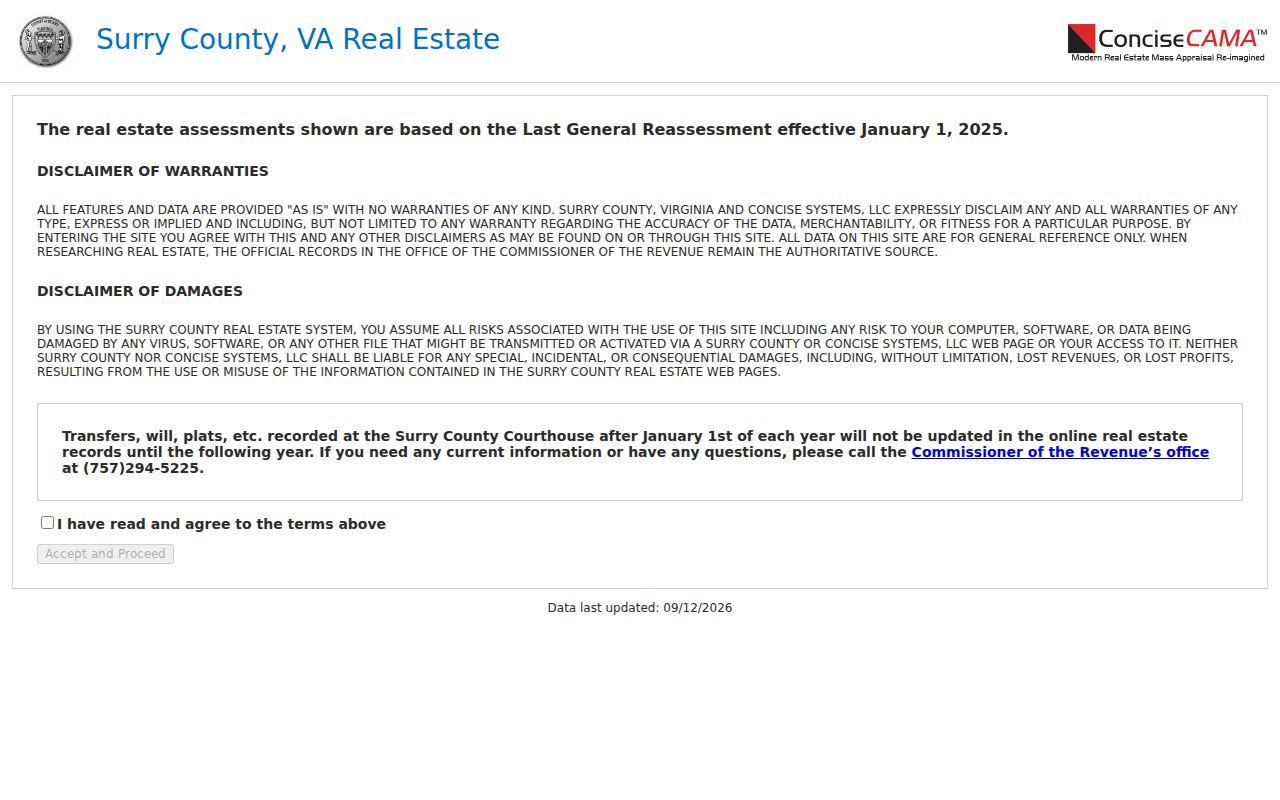
Treat the CAMA disclaimer page as a guide to the assessment's timing, not as a value estimate for any single parcel.
Which Surry County Value Fields the CAMA Card Actually Shows
The public search does not display a live parcel card up front. Exact labels for land, improvement, total value, exemptions, sale date or sketch vary by result. Open your selected CAMA record. Copy only the fields shown, along with the assessment year, the source and the parcel label. A blank sale field does not mean no transfer occurred. The Clerk's deed index is the separate record of consideration and conveyance.
The CAMA system serves as a free reference copy. The Commissioner remains the custodian and can explain an assessment record or an update. The portal may show a land and improvement breakdown. Compare it against the property description, and ask about anything inconsistent. A valuation question also differs from a tax-balance question, which belongs with the Treasurer. Open the official Surry CAMA search and inspect the parcel record yourself.
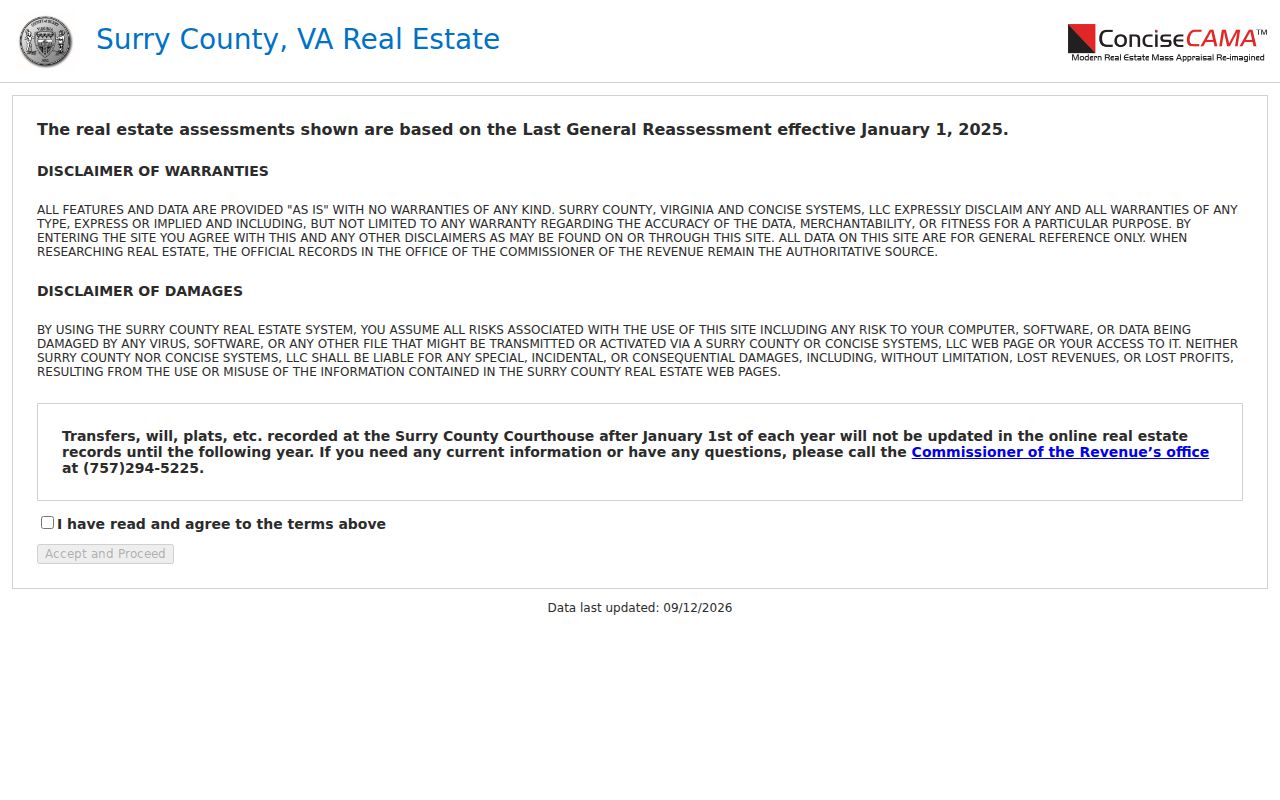
The official CAMA page is only the search doorway; the value fields appear on the parcel record you select.
Look Up a Surry County Assessed Value With Its Effective Year
Begin in Concise CAMA with the property's address or exact map label. When the result card appears, copy the owner of record and parcel description. That way you can confirm the same tract in the Clerk's deed index. Note the effective year beside the total value. A search snippet is never a completed appraisal. If field names differ from what you expected, keep the displayed words rather than translating them into a market claim. Pair them with the deed records before drawing conclusions.
- Search CAMA using the address or parcel identifier available.
- Record the value and effective date exactly as displayed on the assessment record.
- Check the latest deed for a recorded consideration field if the instrument exposes one.
- Use a qualified appraiser for a current market opinion; do not infer one from the GIS map.
- Assessed value
- The real-estate assessment entered on the county roll.
- Fair-market value
- The valuation concept used for the statutory assessment basis.
- Consideration
- A deed-related sale amount; its display in the Surry online index was not verified.
- Effective date
- The date that frames the assessment rather than a promise of current sale price.
Recorded Consideration and Surry County Property Value Are Different
A sale price belongs in the deed and recordation-tax process, not on the assessment roll. Surry County deeds are recorded instruments. An online index may or may not show consideration as a searchable field. Treat any number in an index as unconfirmed. Open the recorded image and read its context first. Some transfers are non-arm's-length. Others carry terms that do not reflect a typical cash sale. Some bundle in items beyond the land itself.
The assessment roll and the recorded consideration can both be accurate yet differ. Each refers to a different event on a different date. Virginia Tax explains how recent assessments relate to recordation value. Still, any title or tax conclusion depends on the actual instrument. Match the deed date and legal description. Be sure the sale covers the same parcel.
Tax Relief Does Not Rewrite the Surry Assessed Value Concept
Elderly, disabled, and disabled-veteran tax relief all run through the Commissioner. Relief can change the taxable amount or the bill. It never changes what assessed value means on the roll. Eligibility rules, application fields, and deadlines shift over time, so ask the office directly rather than applying a generic homestead assumption to Surry County.
A tax ticket shows what is due; the value record shows the assessment. Question the amount billed? Check the Treasurer's current ticket and payment history. Question what the assessed number means? Use the Commissioner and note the effective year. The county's 2025 materials described an appeal process, though a past appeal deadline does not alter the value definition.
For bill, relief, and review details, see the separate Surry County property tax records guide.
Compare a Recent Surry County Sale With the Right Parcel
A recent sale is useful context. It counts only after you confirm the deed describes the same land. The transaction must also be comparable. Surry deeds are indexed by grantor and grantee. Use the CAMA owner and legal description to locate the right instrument. Then check the recording date, the parties, the parcel description, and any visible consideration. No local sale price is asserted here. Surry County publishes no sample deed image for that purpose.
Never treat an adjacent parcel's price as a valuation shortcut. First compare land area, improvements, access, and transaction circumstances. The GIS viewer helps with location context. It is not an appraisal. Virginia's statewide assessment-to-sales ratio study offers locality-level comparison data. It is not an estimate for an individual property.
Limits of a Surry County Assessor Value
An assessor's value is a tax-roll valuation at an effective date. It guarantees no sale price. It does not promise what a lender will accept. Nor does it say what a property would bring in a different market period. CAMA is a reference copy. Its annual ownership update does not mean the assessment is recalculated each time a deed records. For a sale or financing question, a licensed appraiser can offer a property-specific opinion.
Value vs price. An assessed value is used for taxation and is not a sale appraisal or a guaranteed price. For a current market opinion, hire a qualified appraiser.